Summarizing with Spotted Salamanders
Reading to Learn
Madison Tyree
Rationale:
Reading comprehension is the main goal of reading a text. Discovering the overall message of the passage is an important part of reading comprehension. In this lesson, students will learn the important strategy of summarization. Students will summarize a passage by noting the important information, crossing out the unnecessary information, and describe the passage in a few sentences.
Materials:
•Pencils
•Dry Erase Markers
•White Board
•Class Copies of Spotted Salamanders
- https://kids.nationalgeographic.com/animals/amphibians/facts/spotted-salamander
•Ruled Paper for students summarization
•Comprehension quiz for each student
Procedures:
-
Say: “When we read a text, a good reader will not try to remember every little detail that they read. An expert reader will use summarization to learn the most important parts of a story. We can use summarization strategies to remember only the key points the author is making about the topic. Summarization also makes it easier for us to comprehend and remember what we read.”
-
Say: “When we summarize, we can use many methods to help us become better readers. Today we are going to learn about the about-point method. When we use this strategy, we need to ask ourselves 2 questions. What is the text about? What is the main point the author is trying to make? These questions will help us pick out the important parts of the text.”
-
Say: “I am going to give you an article today about spotted salamanders! We are going to practice these summarizing steps on this article you will be reading.” Book Talk: These spotted salamanders are secretive and experts at hiding. Have you ever played hide and seek? What do you think these salamanders are hiding from? Let’s read to find out.
-
Say: “Reading comprehension is understanding the important text in the passage, like the vocabulary. This is an important strategy so let’s practice together! [pass out the article to every student] “We are going to do a few examples from the article.” [find 2 or 3 important vocabulary words from the article: explain the word in simple language, model how to use the word, provide sample questions using the word and scaffold by making a sentence using the word for students to complete.]
Words: Distinctly, Prey
Say: “One of the words in our passage is ‘distinctly’.
-Distinctly- very noticeable, different
-He was distinct because of his red shoes.
-Which of these is an example of being distinct: a brown butterfly or a purple giraffe?
[continue the same process with ‘prey’]
-
Say: “Now that we know how to pick out unfamiliar vocabulary, we are going to learn the about-point strategy to help us summarize this article. [Have the first paragraph written on the board]. Let’s summarize the first paragraph together, and then you will summarize the rest.
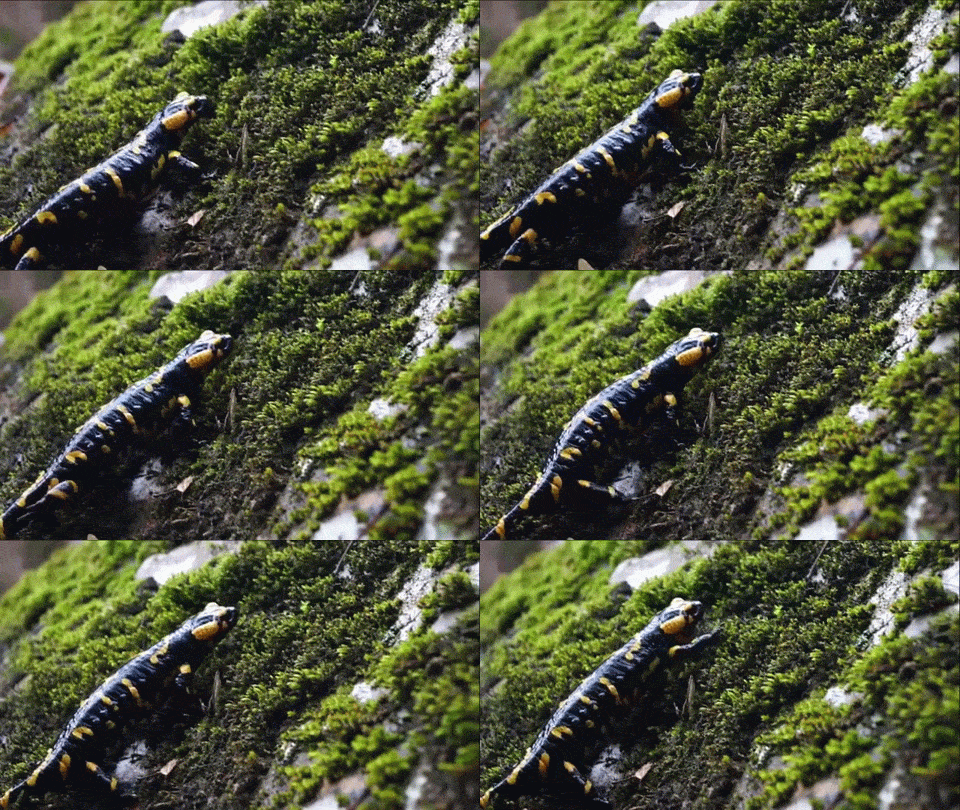
“Though these bluish-black salamanders are large—about seven inches (18 centimeters) long—and distinctly marked with bright yellow or orange spots, they're still not easy to find. They're active only at night. During the day they stay quietly hidden under rocks, leaf debris, and logs. They also use other animals' burrows as their daytime hideouts.”
Say: “What is this paragraph about? It is about the spotted salamanders and some of the traits they have. What are some of the traits you read? They are a bluish-black color and large with bright yellow or orange spots. Why are they not easy to find? Because they are only active at night and stay hidden during the day. Great job! Now let’s try putting these two points together to make a topic sentence: ‘Spotted Salamanders are large, bluish-black, and are only active at night.”
-
Say: “Now you know the about-point strategy, I want you to finish reading the article and try to create a topic sentence for each paragraph. Once you have finished, you will have created a good summary of the spotted salamander article. This will help you remember the important information and facts. Reminder to only use the important ideas in the text and to write them in your own words. Once you turn in your summary you will test your knowledge on the article by taking a short quiz!”
Assessment:
Student’s summary of the article. Evaluate the summarization by using the checklist:
__Collected important facts/information
__Ignored examples
__Reduced the text size from the original article
__Sentences related to the paragraph’s information
__Organized in a paragraph
Quiz:
-
Are spotted salamanders active during the day or at night?
-
What habitat do spotted salamanders live?
-
What kind of animals do salamanders eat?
-
How do salamanders send away predators?
Resources:
https://cem0149.wixsite.com/my-site-1/reading-to-learn
https://murraba.wixsite.com/readinglessons/reading-to-learn
https://deancaroline4.wixsite.com/teachingfluency/reading-to-learn